Friday, 6 October 2017

Monkey Pox: Ten things you need to know about the disease
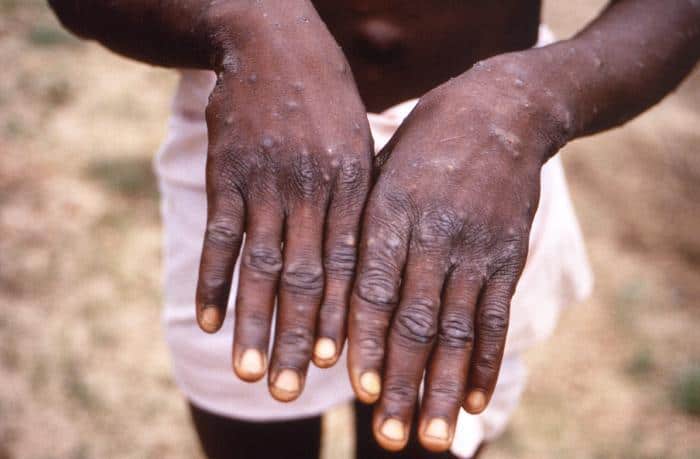
Monkeypox is a rare viral zoonosis (a virus transmitted to humans from animals) with symptoms in humans similar to those seen in the past in smallpox patients, although less severe. Smallpox was eradicated in 1980.However, monkeypox still occurs sporadically in some parts of Africa.
Monkeypox is a member of the Orthopoxvirus genus in the family Poxviridae.

ORIGIN
    The monkeypox virus was first identified in the State Serum Institute in Copenhagen, Denmark, in 1958 during an investigation into a pox-like disease among monkeys.
But it was first identified in humans in 1970 in Zaire (now known as the Democratic Republic of Congo) in a 9 year old boy in a region where smallpox had been eliminated in 1968.

WAS DIAGNOSED IN THE US
In the spring of 2003, monkeypox cases were confirmed in the Midwest of the United States of America, marking the first reported occurrence of the disease outside of the African continent.
Most of the patients had had close contact with pet prairie dogs.

INFECTION
Infection results from direct contact with the blood, bodily fluids, or cutaneous or mucosal lesions of infected animals.
Human infections have also been documented through the handling of infected monkeys, rats and squirrels, with rodents being the major reservoir of the virus. Eating inadequately cooked meat of infected animals is a possible risk factor.

TRANSMISSION
Transmission occurs primarily via droplet respiratory particles usually requiring prolonged face-to-face contact, which puts household members of active cases at greater risk of infection.
Transmission can also occur by inoculation or via the placenta (congenital monkeypox). There is no evidence, to date, that person-to-person transmission alone can sustain monkeypox infections in the human population
 Secondary, or human-to-human, transmission can result from close contact with infected respiratory tract secretions, skin lesions (open wounds/injuries) of an infected person or objects recently contaminated by patient fluids or lesion materials.
DURATION
The incubation period (interval from infection to onset of symptoms) of monkeypox is usually from 6 to 16 days but can range from 5 to 21 days.
Monkeypox is usually a self-limited disease with the symptoms lasting from 14 to 21 days.
SYMPTOMS 
The infection can be divided into two periods:
The invasion period (0-5 days) characterized by fever, intense headache, lymphadenopathy (swelling of the lymph node), back pain, myalgia (muscle ache) and an intense asthenia (lack of energy);
The skin eruption period (within 1-3 days after appearance of fever) where the various stages of the rash appears, often beginning on the face and then spreading elsewhere on the body.
       The face (in 95% of cases), and palms of the hands and soles of the feet (75%) are most affected.
RISK FACTOR
People living in or near the forested areas may have indirect or low-level exposure to infected animals, possibly leading to subclinical (asymptomatic) infection.
The case fatality has varied widely between epidemics but has been less than 10% in documented events, mostly among young children. In general, younger age-groups appear to be more susceptible to monkeypox.
DIAGNOSIS
Monkeypox can only be diagnosed definitively in the laboratory where the virus can be identified by a number of different tests.
The differential diagnoses that must be considered include other rash illnesses, such as, smallpox, chickenpox, measles, bacterial skin infections, scabies, syphilis, and medication-associated allergies.
TREATMENT/VACCINE
There are no specific treatments or vaccines available for monkeypox infection, but outbreaks can be controlled.
Vaccination against smallpox has been proven to be 85% effective in preventing monkeypox in the past but the vaccine is no longer available to the general public after it was discontinued following global smallpox eradication.
PREVENTION
In the absence of specific treatment or vaccine, the only way to reduce infection in people is by raising awareness of the risk factors and educating people about the measures they can take to reduce exposure to the virus.
Regular hand washing should be carried out after caring for or visiting sick people.
   Reducing the risk of animal-to-human transmission. Efforts to prevent transmission in endemicregions should focus on thoroughly cooking all animal products (blood, meat) before eating.
Public health educational messages via the media – broadcast, electronic and social – is highly advised.
Healthcare workers and those treating or exposed to patients with monkeypox or their samples should consider being immunized against smallpox via their national health authorities.

AT THE END OF THE STORM, SURELY THERE'S A SILVER LINING.

Give Jurgen Klopp time — he's DEFINITELY the right manager for Liverpool, says Anfield legend Kevin Keegan

The Reds have kept only two clean sheets this season after two years under the German but former star has faith
Kevin Keegan has urged ­Liverpool to give Jurgen Klopp the time to finish the job at Anfield.
The Reds have been haunted by ­defensive frailty but former England manager Keegan claimed all top Premier League teams now struggle defensively because of changes to the laws.
The former Kop star, 66, preferred to go to wine-tasting on Thursday night rather than watch England qualify for the World Cup.
But though Keegan insisted he does not miss football, his world-weariness was replaced by enthusiasm when asked about the German who took over his former club two years ago.

Liverpool can be electric going forward — but the defending's often shocking...
“I enjoy watching Liverpool — I think he’s ­definitely the right guy,” said the ex-­Newcastle and Manchester City boss. “He gets Liverpool, he gets the ­humour. The fans like him. They don’t want a manager with a notepad, they want him kicking every ball.
“I think they like the style of football he plays. Yes, they are conceding goals and they say it’s a bit like my team at Newcastle. But at Liverpool, and at Newcastle really, fans want the same thing.

“They want to see a good game of football and they want the team to have a go.
“The older Liverpool fans were used to that from when Bill Shankly came in right through until the Premier League was formed.
“I think he’s a great manager. He fits Liverpool. You can understand what he is saying, he doesn’t talk in riddles, he says what he thinks.

Keegan even compared Klopp's side to his own swashbuckling Newcastle teams
“I don’t think he is going to win the league this season. I don’t think even Jurgen Klopp thinks that or even the most optimistic fan. But top four is ­feasible again. Liverpool are a work in progress.
“I hope they have patience with him if it doesn’t actually go right because he is the right guy.”
Liverpool have kept only two clean sheets in 12 matches this season.

But Keegan, making a rare public ­appearance at the Aspire for Sport ­Congress, said: “There are a lot of teams in the Premier League struggling in defence.
“All the rules have been changed to suit attackers – yellow cards, red cards.
“It’s no fun being a defender. If a defender misses three tackles he’s off, so no wonder they are cautious.”

WHAT CAN THE FUTURE OFFER, WHEN THE PRESENT IS NOT CERTAIN.

Pope Francis: We must do more to protect children from online abuse

The Pope criticised the 'dark net' where 'evil finds ever new, effective and pervasive ways to act and to expand'
Acknowledging how often the Catholic Church failed to protect children from sexual abuse, Pope Francis pledged “to work strenuously and with foresight for the protection of minors and their dignity,” including online.
“As all of us know, in recent years the church has come to acknowledge her own failures in providing for the protection of children: Extremely grave facts have come to light, for which we have to accept our responsibility before God, before the victims and before public opinion,” the Pope said on October 6.
Pope Francis welcomed to the Vatican participants from an international congress on protecting children in a digital world. Hosted by the Pontifical Gregorian University’s Center for Child Protection in partnership with WePROTECT Global Alliance, the congress Oct. 3-6 was designed to get faith communities, police, software and social media industries, mass media, nonprofits and governments working together to better protect minors.
At the beginning of the audience, Muireann O’Carroll, a 16-year-old from Ireland, summarized the congress conclusions “on behalf of all children.”
Participants appealed to governments, church leaders and tech companies to do everything possible to remove online images of children and young people being sexually abused, identify and help those children, and end cyberbullying and “sextortion,” which is using sexual images to blackmail someone. They also asked people involved in health care to increase the training needed to know when a young patient is being abused and how to help them.
Pope Francis told the group that as a result of the “painful experiences” of seeing some of its clergy abuse children, but also as a result of “the skills gained in the process of conversion and purification, the church today feels especially bound to work strenuously and with foresight for the protection of minors and their dignity, not only within her own ranks, but in society as a whole and throughout the world.”

The 80-year-old Pope said that with the explosive growth of digital technology, “we are living in a new world that, when we were young, we could hardly have imagined.”
“If, on the one hand, we are filled with real wonder and admiration at the new and impressive horizons opening up before us,” he said, on the other hand, its quick and widespread development has created new problems.
“We rightly wonder if we are capable of guiding the processes we ourselves have set in motion, whether they might be escaping our grasp, and whether we are doing enough to keep them in check,” Pope Francis told the group.
The “extremely troubling things on the net,” he said, include “the spread of ever more extreme pornography, since habitual use raises the threshold of stimulation; the increasing phenomenon of sexting between young men and women who use social media; and the growth of online bullying, a true form of moral and physical attack on the dignity of other young people.”
In addition, he said, there is the phenomena of sextortion and the solicitation online of minors for sexual purposes, “to say nothing of the grave and appalling crimes of online trafficking in persons, prostitution and even the commissioning and live viewing of acts of rape and violence against minors in other parts of the world.”
“The net has its dark side — the ‘dark net’ — where evil finds ever new, effective and pervasive ways to act and to expand,” the Pope said. “The spread of printed pornography in the past was a relatively small phenomenon compared to the proliferation of pornography on the net.”
The problem is huge and global, the Pope said, and no one should underestimate the harm children and young people face.
“Neurobiology, psychology and psychiatry have brought to light the profound impact of violent and sexual images on the impressionable minds of children, the psychological problems that emerge as they grow older, the dependent behaviours and situations, and genuine enslavement that result from a steady diet of provocative or violent images,” he noted.
“The spread of ever more extreme pornography and other improper uses of the net not only causes disorders, dependencies and grave harm among adults, but also has a real impact on the way we view love and relations between the sexes,” he said. “We would be seriously deluding ourselves were we to think that a society where an abnormal consumption of internet sex is rampant among adults could be capable of effectively protecting minors.”
While the internet has given people greater access to information and a vehicle for self-expression, it is not simply “a realm of unlimited freedom” without consequence, the Pope said. The freedom of the internet “also offered new means for engaging in heinous illicit activities,” often with children as their victims.
“This has nothing to do with the exercise of freedom,” Pope Francis insisted. “It has to do with crimes that need to be fought with intelligence and determination, through a broader cooperation among governments and law enforcement agencies on the global level, even as the net itself is now global.”

ARE THE REALLY THAT POWERFUL (WOMEN).

Hoodlums in Lagos fight over girlfriend, destroy over 150 vehicles

-Thugs clash in Lagos state, leaving many injured and several vehicles destroyed.
-Many affected residents still counting their losses.
-Police have increased constant patrol of affected areas.

         The Idi Araba and Olorunishola communities in the Mushin Local Government Area of Lagos State was thrown into confusion following the bloody clash between two factional gangs in the neighbourhoods.
Up to 150 vehicles parked on roadsides and even in the compounds were reportedly destroyed during the clashes, which also left some of the hoodlums injured.
         The clash was the result of a fall out in the ongoing battle for supremacy between Idi Araba boys and Olorunnishola boys.
Reports obtained, indicated that the two gangs had been at logger heads for close to four years but the rivalry was reignited last week Saturday during a party organised by a lady on Olanrewaju Street, off Itire Road.
The celebrant was reportedly in a relationship with two men, each from the two factions, with both factions attending the party.
          An eyewitness, who refused to give his name, said one Faruk of Olorunnishola boys escalated the fight after he smashed a bottle on Abbey, a “strong member of Idi Araba boys which thereafter led to a reprisal attack”
In his words, “Olorunishola boys also came to Idi Araba, Folarin Street and other neighouring streets around 12.30am on Sunday, September 10. They destroyed about 150 vehicles.
“Idi Araba boys comprised thugs from Daniyan, Sea Side, Lawanson, Odutan and Adekunle areas; and they are led by Emo, Sule Jagaban and Bere.
“Olorunishola boys also comprised hoodlums from Daniel, Morgan, Shittu, Igbeyin Adun streets and Ojuwoye in Mushin. They were led by Mopol and Bobo. Some of them are cult members.
          “The lady that organised the party was dating members of both factions. The lady was given a post in her church and she celebrated it on that day. The party could not contain the two rival gangs.”
Another resident and eyewitness, simply identified as Samuel, said the hoodlums hided under the umbrella of the unrest to rob residents of their valuables.  
“Apart from destroying property, they entered into houses to steal laptops, generators, televisions and other items. Everybody here is afraid. We need more security and we want the police to stop the gangs from causing more havoc,” Samuel said.
Lukman Ninalowo, a car dealer, said his car and that of his wife, parked on Folarin Street, were destroyed during the clash.
       He said, “They damaged the two cars – Mitsubishi and Sienna – and I have reported the vandalism at the Itire Police Division. They broke the glass on the driver’s side of the Mitsubishi and smashed the windscreens of the Sienna. They came at night armed with cutlasses.
“Over 40 vehicles were vandalised on Folarin Street alone. They also entered premises and destroyed vehicles, including a car that a mechanic repaired for his customer.
   “We urge the Lagos State Police Command to deploy more operatives in this area to support the Itire division. We learnt that four of the suspects were arrested and taken to court.”
Another victim, Mr. Taiwo Adeneike, a civil servant said, he had no idea of how to raise fund to repair his vandalised car.
           “They broke the windscreen and the driver’s side glass of my BMW E36. The fight has been on for a long time, but that of Sunday assumed another dimension. I had slept off. I suddenly started hearing noises. By the time I came out, a lot of vehicles had been destroyed. The DPO of the Itire Police Division came that night,” he added.
The Chairman, Ifetedo Community Development Association, Ishaga Close, Idi Araba, Mr. Rasheed Bakare, called on the state government to intervene, noting that the gangs had created panic in the affected communities.
          He said, “The cause of their fight is always baseless. Whenever they clash, it is innocent residents who bear the brunt. Vehicles parked on Itire Road, Morgan, Olorunishola, Durojola streets and Lawanson were damaged Over 100 vehicles were vandalised. I personally counted over 50 damaged vehicles on Folarin Street.
“Whenever there is any misunderstanding, they start destroying property and robbing people. We want the state government to intervene because it is getting out of hands.”
Reacting to the mayhem, the Lagos State Police Public Relations Officer, ASP Olarinde Famous-Cole, said the police had responded to the incident and launched a regular patrol of the areas.
He said, “Arrests were made and suspects have been charged to court. A raid was also conducted and five male suspects were taken to the Lagos State Task Force office in Oshodi.
“Apart from police patrol, we are also holding meetings with stakeholders in the communities to avoid any breakdown of law and order.”